-
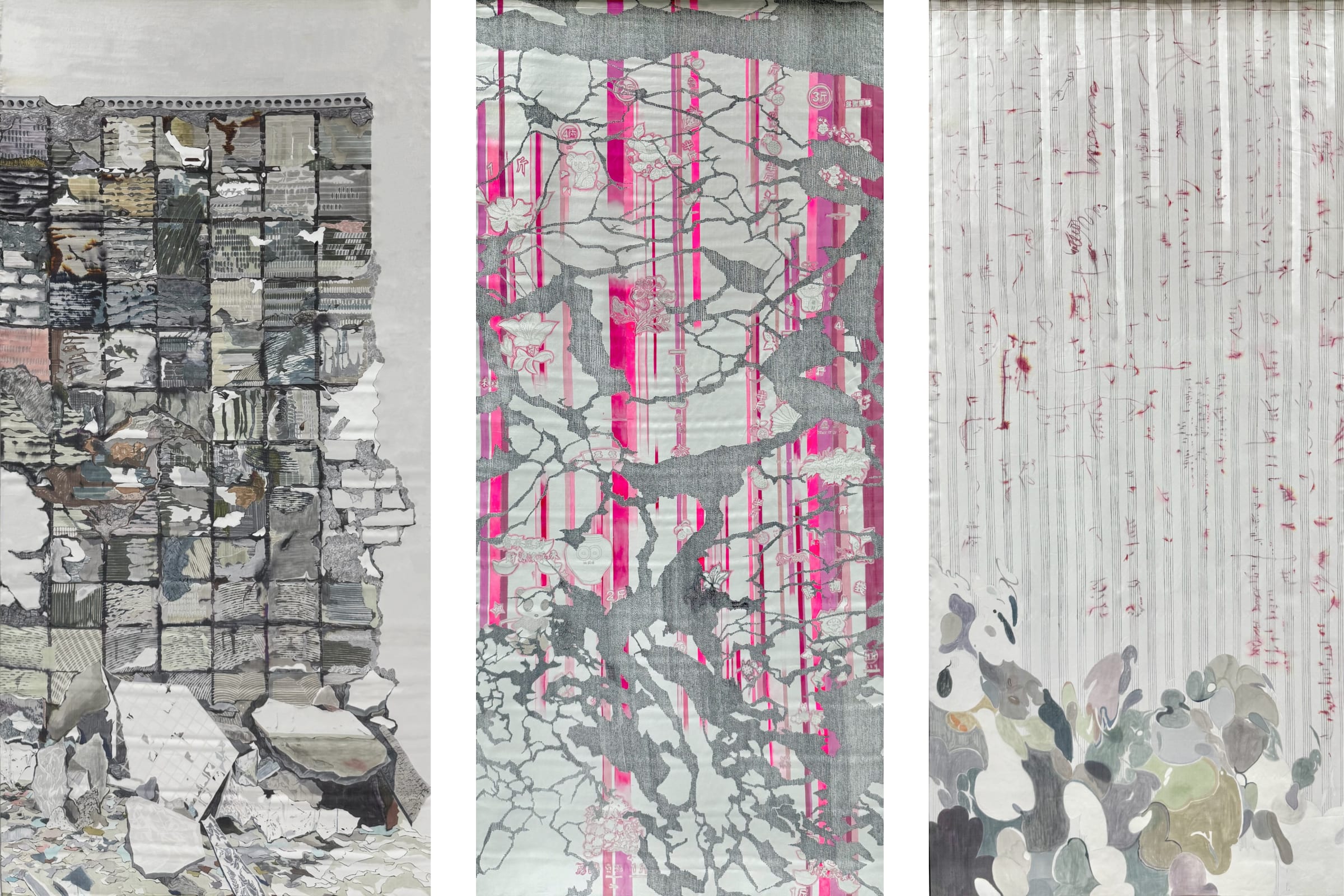
After two rounds of judging, the Liu Kuo-Sung Foundation and The Ink Society were delighted to announce Hung Hsuan the Winner of the Fourth Liu Kuo-sung Ink Art Award, with a cash prize of HKD100,000; Honorable Mentions were awarded to Zhang Wenzhi and Huang Jingjie, with cash prizes of HKD20,000 each. The award ceremony was held on October 4, 2025 at Fine Art Asia, and the works of the three winners were exhibited at The Ink Society’s Special Exhibition Zone.
Nominators
Cui Cancan (Independent curator, Beijing)
Jiang Jun (Independent curator and art critic, Hangzhou)
Lee Ho Cheung (Former Assistant Curator (Xubaizhai), Hong Kong Museum of Art, Hong Kong)
Sun Dongdong (Independent curator and art critic, Beijing)
Wu Chi-tao (Artist; Assistant Professor, Taipei National University of the Arts, Taipei)
Judges
Lai Hsiang-ling (Director, New Taipei City Art Museum, New Taipei City)
Nancy Lee (Director, The Ink Society, Hong Kong)
Liu Kuo-sung
Alan Yeung (Associate Curator, Ink Art, M+, Hong Kong)
Zhang Zikang (Professor, Central Academy of Fine Arts, Beijing)
-
Lai Hsiang-ling on Hung Hsuan:
“︀
Hung Hsuan graduated from the Taipei National University of the Arts. For her, ink is not only an exploration of traditional culture, but a means through which to reconstruct life experience. She was exposed to ink art from an early age, which fostered her deep interest in traditional culture and artistic forms involving different formats of writing. She has thus also continued to use ink as the core of her creative practice. Through serial experimentation, she confronts the contemporary challenge of reflecting our current ethos and life in the ink medium while continuing to innovate in its techniques and forms.
Hung often takes inspiration from daily observations, recording her encounters with her phone, and she turns elements of ancestral worship and vernacular culture as well as folk images into her creative vocabulary. Her works combine observation and imagination, and they open up new ways of seeing through symbolism, meaning, color and compositional reconstruction and juxtaposition. While displaying strong intention, her works also retain the charm of spontaneity, gradually shaping a distinct personal style.
Regarding her material experimentation, Hung creates works with silk, paper and mixed-media that integrate industrial found-objects. She continuously overturns the inherent properties of materials—from blending ink and acrylic paint to making her own fluorescent pigment to create halo-like textures. Through the interweaving of ink play, line drawing techniques and different kinds of framing, Hung constructs multi-layered pictorial spaces.
In terms of display, Hung strives to break through traditional formats of framing and expands two-dimensional painting into spatial installations that integrate multiple works and objects, creating sites of viewing that integrate multiple messages. This kind of expanded perceptual experience guides the audience to reflect on the ink tradition from new perspectives and consider its creative potential in the contemporary context.
For the Fourth Liu Kuo-sung Ink Art Award, Hung has submitted a set of three vertical screens: Longitude Erected, Adamant Rock and A Song in Progression. Through unconventional brushwork, color composition and experimental framing, the works simulate urban landscape, daily experience and the flow of time and space, revealing her expansion of ink vocabularies, as well as an experimental spirit in formal aesthetics. The works not only continue Hung’s exploration of ink art’s contemporaneity, but also reflect her strong personal style and a distinct sense of the times. Thus, her work has received the judges’ unanimous recognition.
”︀
Alan Yeung on Honorable Mention awardeeson:
“︀
Zhang Wenzhi engages with the history of northeast China, particularly his native Dalian. He uses the medium of ink on paper to mix and fuse a variety of images drawn from classical mythology, as well as references to maritime science and trade, war, colonialism and urbanisation. These different layers of history become tangled in Zhang’s paintings, forcing the viewer to confront their complexity. Huang Jingjie evokes paper-folding in delicate color washes that subtly overlap and transition into each other. The resultant layers appear by turns natural (like mountains and coastlines), artificial (as if torn by hand) and mediated by a digital screen, hovering dreamlike between flatness and landscape.
This year, the judges had to consider finalists with highly distinctive practices, which made comparison and decision difficult. Nonetheless it is possible to discern some common ground between Zhang and Huang. Both paint appealing and densely-layered images that belie disturbing realities, like war or environmental disaster. Both also allude to bapo (‘eight brokens’), a genre of painting that pastiches fragments of cultural artifacts in an illusionistic manner. Bapo flourished during the late 19th and early 20th centuries, when China was under stress from Western industrialised modernity. The questions it raised about the meaning of traditional culture remain resonant in the age of AI.
Working in the wake of the post-2000 neo-gongbi movement, Zhang and Huang employ techniques and styles associated with court and professional painters: Zhang with his detailed animals and architecture, and Huang with his delicate layers of color washes on silk. Like recent winners and finalists of the Liu Kuo-sung Ink Art Award, they challenge the stereotype of ink art as monochrome gestural abstraction, and help to redirect the field beyond medium, style and aesthetics toward discourse, deconstruction and critical reflexivity. In this sense, they carry on Master Liu’s revolutionary spirit.
”︀
-

-
-
Fourth Liu Kuo-Sung Ink Art Award 2025
Current viewing_room